
Buyers don't pay full price for a company that can't run without you.
Every acquirer prices the same question first: what happens to this business when the owner walks away? If the honest answer is "it wobbles," you'll hear it in the offer — long before you hear it out loud.
The diligence room is not a friendly place.

I've sold two companies. Both diligence processes were demanding; the second — run by a strategic acquirer working with a top-tier Silicon Valley law firm — was the hardest professional exam of my life. And here's what surprised me: the toughest questions weren't about the numbers. The numbers were the easy part. The hard questions were about the people. Who owns these customer relationships? Who makes this decision when you're not here? Can your team explain the strategy — without you in the room?
That last one is the test most founder-led companies fail. Diligence teams interview your leaders separately, on purpose, and they're listening for one thing: whether the story holds together when the founder isn't there to hold it. A company that runs on the owner alone doesn't just make the process harder — it shows up in the price. Usually quietly. Always expensively.

During the sale of my second company, one of my advisors had a phrase for the work of getting ready: polishing the apple. Making sure everything is in order — clear products with usable data, a real org chart, and a management team that can speak for the business without you. I've done that work twice under a buyer's microscope. Now I help owners do it years before a buyer ever shows up — when there's still time for it to change the outcome.
Polishing the Apple:
The Readiness Assessment
A fixed-fee engagement, two to three weeks, built to answer one question: how does your company look to a buyer's diligence team — today?
Who it's for: owners who think a sale is realistically two to five years out. That's the window where this work changes the outcome — close enough that readiness matters, far enough that the big dimensions still have time to move. Closer than two years, we're triaging; further than five, you're simply building a well-run company — which is never wasted, but carries a different urgency.
1. The document review.
You receive a document request list — a deliberately condensed version of what a real buyer's team sends. What you can produce easily, what takes digging, and what doesn't exist yet: all three are data.
2. The leadership interviews.
I sit down with your top team, individually, without you in the room — because that's exactly how a buyer will do it. The gap between how the company describes itself and how your leaders describe it is the single most valuable finding in the assessment.
3. The scored readout.
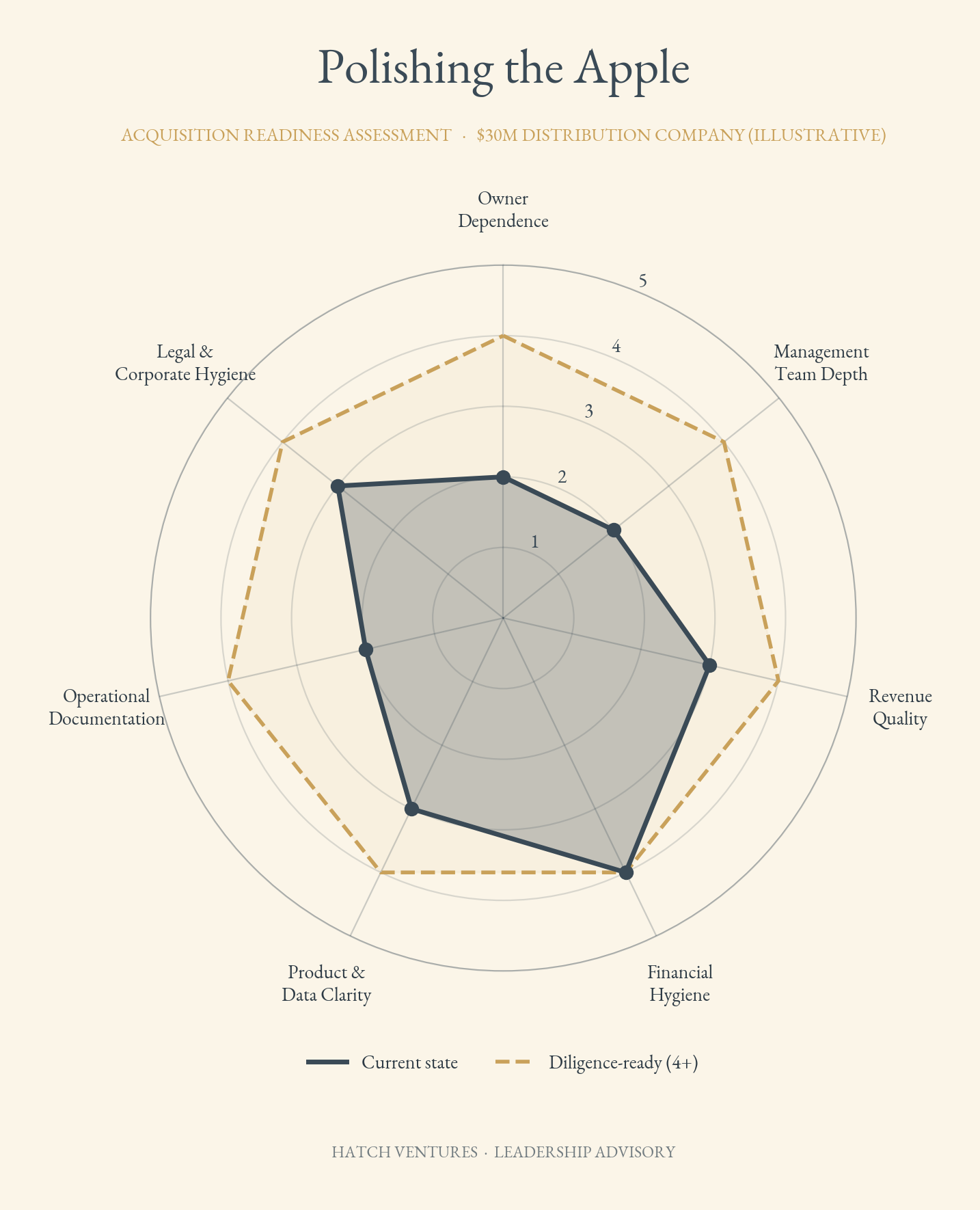
Seven dimensions of readiness, scored the way a buyer scores them: owner dependence, management team depth, revenue quality, financial hygiene, product and data clarity, operational documentation, and legal hygiene. You leave with a composite readiness score, a red-flag list ranked by what each issue costs in a deal, and a 12–24 month roadmap — honest about which work is mine, and which belongs with your CPA and your deal counsel.
What twelve months of deliberate work buys.
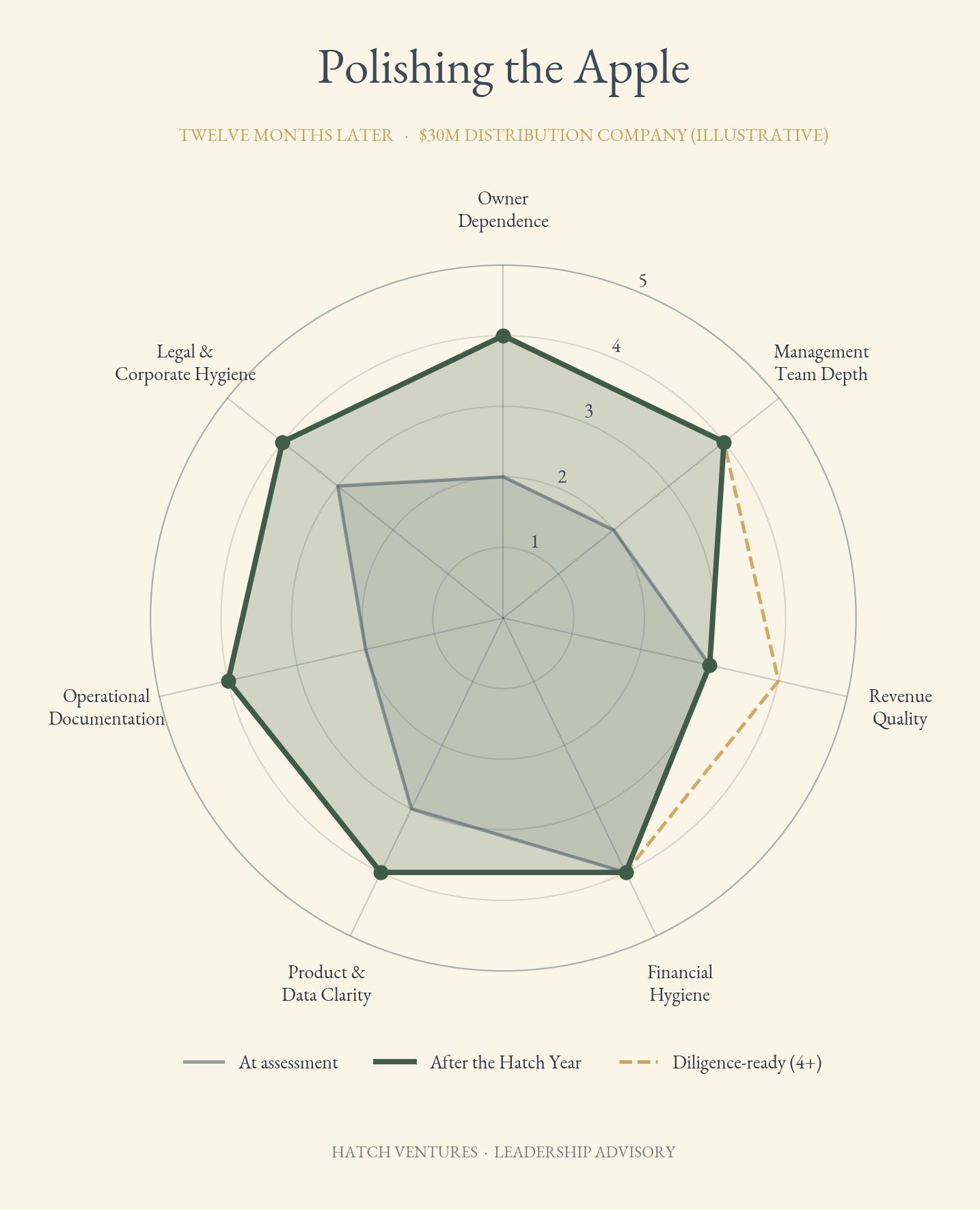
Most founder-led companies assess the same way: the financials are fine — your CPA has seen to that — but owner dependence, team depth, and documentation sag well below what diligence rewards. Those are precisely the dimensions that move with focused work. The companies that do it enter the room with a leadership team that can carry the questions, a story that holds without the founder in the chair, and a buyer who leaves sessions more confident than they arrived.
That's not a coincidence of good luck. It's the same work that grows a company: building a leadership team the business can run on. The work that makes your company worth more is the work that makes it run without you — whether you sell in two years or never.
And that's why the timing matters. This work belongs well before a buyer is in the picture — not because readiness takes time (though it does), but because the assessment pays for itself long before any sale. The readout gives your leadership team something most companies never write down: clarity about how they need to operate and stay organized. Who owns which decisions. What lives in documents instead of memory. What a well-run version of each function actually looks like. Done early, it's not sale prep — it's the operating standard your team runs on for years. The exit, if it comes, simply inherits a company that's already in order.
The best time to polish the apple is before anyone's looking at it.

If you think a sale is two to five years out, this is the moment this work was built for — the readiness conversation costs you an hour and changes what you do with the time you have. Sooner than that, come anyway; we'll triage. And if a sale isn't on the horizon at all, the same conversation gives your leadership team an operating standard to run toward. The founders who wait for a buyer to force the question are the ones who discover it in the diligence room — at the one moment it can no longer be fixed.